AI Chatbot for Insurance Agents: Buyer's Guide
AI chatbots for independent insurance agents, explained for the 1-10 person agency: real use cases, what to avoid, agency-economics cost math.
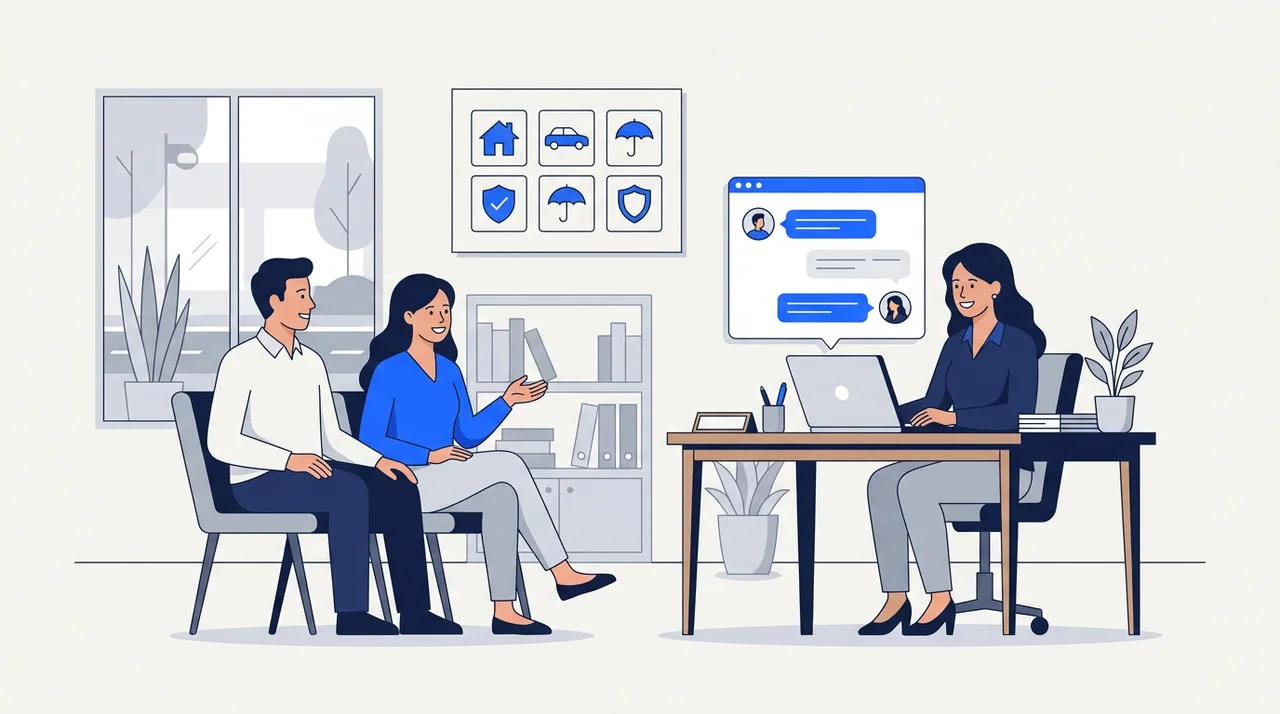
Search "AI chatbot for insurance agents" and nearly everything that ranks was written for a carrier. GEICO-scale claims automation, Fortune 100 case studies, underwriting-distribution assistants, 20 million calls a year. None of that describes a five-person independent agency writing home and auto policies in one metro area. The keyword names the independent agent as the buyer; the content doesn't talk to them.
That gap is the reason for this guide. Small agencies are not a rounding error in this industry, even though the industry is consolidating: a widely cited pre-pandemic figure put around 85% of independent agencies at 10 or fewer employees, and consolidation since then has trimmed that share, though we couldn't pin down a reliable, current, sourced number to replace it — take "most independent agencies are small" as directionally true rather than an exact figure. Either way, the small end of the market is still a very large, very real buyer, and it's the one this content gap leaves unserved. What a chatbot should do for that buyer is a narrower, more useful question than "how is AI transforming insurance."
We build AI chatbots for small US service businesses, insurance agencies included, so treat the framing here as informed by that work rather than neutral in the abstract. Where we think a chatbot is the wrong tool for something, we say so directly.
Who this guide is for (and who it isn't)
This is written for the owner or office manager of an independent insurance agency: captive or independent, writing personal or small commercial lines, somewhere between one location and a handful, with a small staff answering phones and email during business hours and effectively unavailable outside them. If you run claims operations for a carrier, manage a TPA book, or sit inside an enterprise contact center, the vendor guides written for that scale are the right ones to read; the recommendations below will feel undersized for your operation.
If you're the small agency the keyword actually names, keep reading. The scale difference matters more than most guides admit, because what an AI chatbot should be allowed to do changes with it.
What an AI chatbot actually does for an independent agency
At agency scale, a chatbot is a front-of-house tool that catches the work your team either does manually during business hours or misses entirely after them, not a claims-processing engine. The tasks that fit:
- After-hours quote requests. A visitor lands on your site at 8 PM wanting a home-and-auto bundle quote. The chatbot collects the basics (name, contact info, property or vehicle details, current carrier if any) and either books a callback slot or hands the lead to your agency management system, instead of the visitor closing the tab and requesting a quote from the next agency in the search results.
- Renewal reminders and pre-renewal check-ins. Automated, scheduled nudges ahead of a policy renewal date, with a chat-based path to request a coverage review rather than auto-renewing without a second look.
- Certificate of insurance (COI) requests. A common, low-complexity, high-frequency request for commercial-lines clients (a contractor needing a COI for a job site, for example) that a chatbot can intake and route to whoever issues COIs at your agency, cutting the back-and-forth email chain to one submission.
- Claims-status FAQ, routed to the carrier's own portal. The chatbot doesn't process the claim. It answers "who do I call" and "where do I check status" and links straight to the carrier's claims portal or hotline, the same information your staff would give over the phone.
- Cross-sell qualification. A client asking about auto coverage gets a scripted, low-pressure prompt asking whether they also want a home or umbrella quote, logged for a producer to follow up on, not a hard sales push from the bot itself.
Every item on that list is lead capture, scheduling, or FAQ routing. None of it is a decision about a person's risk or coverage. That line matters enough to get its own section.
What it should never do: the underwriting and advice line
This is the guardrail independent agents should hold their vendor to, stated plainly because at least one vendor in this category edges toward the opposite: a chatbot should never assess, score, or imply a judgment about a caller's risk, eligibility, or coverage adequacy. "Should I increase my liability limits?" and "will this claim get denied?" are questions for a licensed agent, not scripted chatbot output, even when the chatbot could technically generate a plausible-sounding answer.
Practically, that means the chatbot's job stops at collecting information and routing it to a human. It can ask "what's your current dwelling coverage limit?" as a data-gathering question for a producer to review. It should not follow up with "based on that, you may be underinsured" — that's advice, and advice is a state-licensing and E&O-liability question your agency, not a chatbot vendor, is on the hook for. If a vendor pitches "dynamic risk assessment" or similar decisioning language as a chatbot feature, ask exactly what the bot outputs and to whom. If the answer touches anything that looks like a coverage or risk recommendation surfaced directly to the client, that's a scope you want to avoid, not a feature to buy.
Kept inside that boundary, a chatbot for an independent agency sits in the same lead-capture-and-scheduling lane as a well-run receptionist desk, not in claims or underwriting territory.
Will it sound like a call center to a client I've had for 12 years?
Independent agents compete on something carriers largely can't replicate: a client who calls and gets someone who actually remembers their policy history. None of the guides that rank for this keyword address the real worry that comes with adding a chatbot to that relationship, which isn't "does the technology work" but "does this make my agency feel less like the place Mrs. Chen has trusted for 12 years and more like a call center."
Three things determine which way that goes:
- Scope discipline. A chatbot that stays inside lead-capture, COI requests, and FAQ routing reads as a helpful front door. A chatbot that tries to hold a full conversation about coverage changes reads as a company that stopped listening to its clients.
- Instant human handoff. Any client who types something like "I want to talk to someone" or "this isn't working" should get a direct path to a real person immediately, not another scripted prompt. Long-tenured clients notice friction fast, and a chatbot that tries to keep the conversation is the fastest way to lose the trust that took a decade to build.
- Where it shows up. A chatbot on your website's after-hours quote form is a convenience. A chatbot that intercepts every inbound call from existing clients is a downgrade. Most independent agencies get the balance right by scoping the chatbot to web-based, asynchronous interactions (new business, after-hours, COI, FAQ) and keeping phone calls from existing clients going to a human during business hours.
The honest framing: a chatbot protects the relationship by catching the business you'd otherwise lose to unavailability, not by replacing the conversations that make the relationship worth having in the first place.
What it costs and what it's worth: agency economics, not market-size stats
Most competing guides open with category-level market-size projections, figures like the insurance chatbot market reaching several billion dollars globally by the early 2030s. That's a real growth trend, but it tells an individual agency owner nothing about whether the tool is worth buying. Agency economics is the number that matters, and it starts with what a missed after-hours inquiry actually costs.
A rough, agency-level way to think about it: if your average new personal-lines policy carries roughly $400-$800 in first-year commission (the range varies by carrier, line, and state, so use your own book's numbers if you have them), and your agency's website gets after-hours quote inquiries a few times a week that currently go unanswered until the next business day, each one you lose to a competitor who responds first is a lost commission, not just a lost lead. A chatbot's job is narrowing that gap: capturing the inquiry the moment it happens, even if a producer still closes it the next morning.
On the cost side, chatbot platforms built for small businesses typically run in the low hundreds of dollars per month, well under the cost of an additional part-time front-desk hire, and don't require staffing after hours. Whether that math works for a specific agency depends on how many after-hours or overflow inquiries the agency is actually losing today, which is worth tracking for a few weeks (a simple log of "quote requests we know arrived outside business hours") before signing with any vendor.
Independent agency vs carrier chatbot: why most guides don't apply to you
It's worth being explicit about why the top-ranking content for this exact keyword mostly misses the mark, because it explains what to ignore when you're evaluating vendors. Most published guides on "AI chatbots for insurance" are written by vendors selling into carriers and large enterprise operations, and their examples show it: claims automation at the scale of millions of calls a year, First Notice of Loss (FNOL) intake across a national book, identification-and-verification (ID&V) automation for call centers, underwriting-distribution assistants for large producers. Real capabilities, aimed at a different customer.
An independent agency doesn't need FNOL-at-scale; it needs the after-hours quote request answered before the prospect calls the next agency. It doesn't need enterprise ID&V; it needs a COI request routed to the right person without six email replies. The gap between those two use cases is the reason a carrier-oriented chatbot vendor's pricing, setup process, and feature list rarely fit a 5-person agency cleanly. If a demo spends most of its time on claims-scale features, that's a signal the vendor's core customer isn't you.
How to evaluate a vendor: a short checklist
Independent of which vendor you talk to, these are the questions worth asking before signing anything:
- Does the bot stay inside lead-capture, scheduling, and FAQ routing, or does it offer risk/coverage-adjacent output? If it's the latter, ask your compliance contact or state insurance department before proceeding.
- How fast and how clearly does it hand off to a human? Ask for a live demo of a client typing "I want to talk to a person," not just the happy path.
- Does it integrate with your actual agency management system (AMS360, EZLynx, HawkSoft, or whatever you run), or does it dump leads into a generic inbox someone has to manually re-enter?
- What does it cost at your actual volume, not a marketing tier priced for a bigger book than yours?
- Does the vendor understand state-level bot-disclosure rules? Some states have specific requirements about disclosing that a website visitor is talking to an automated system, not a licensed agent. A vendor that hasn't thought about this is a vendor that hasn't sold into insurance agencies before.
- Can you see it running for another agency your size, not just an enterprise logo on the vendor's homepage?
A vendor that answers all six cleanly is worth a pilot. A vendor that can only answer the first two is probably selling a generic chatbot with an insurance label on it.
FAQ
Is an AI chatbot the same as an insurance chatbot for claims processing? No, and that distinction matters. Claims-processing chatbots operate at carrier scale, ingesting First Notice of Loss and automating parts of the claims workflow. What an independent agency needs is much smaller in scope: lead capture, scheduling, COI requests, and FAQ routing to the carrier's own claims portal. If a vendor pitches claims automation to a 5-person agency, that's a mismatch worth questioning.
Can a chatbot give clients advice about their coverage? It shouldn't, and a chatbot vendor that lets it drift into that territory is a liability risk for the agency, not just a nice-to-have overreach. Coverage recommendations are a licensed-agent function. A well-scoped chatbot collects information and routes it to a person; it doesn't tell a client whether they're underinsured.
How much does an insurance agency chatbot cost? Small-business chatbot platforms generally run in the low hundreds of dollars per month, though pricing varies by vendor, feature set, and volume. Compare that cost against what your agency is currently losing to missed after-hours inquiries before deciding whether the spend is worth it.
Do independent insurance agents actually need this, or is it a carrier-only tool? Independent agencies are the underserved side of this category. Most chatbot vendors write and build for carriers and large enterprise operations; the tools that fit a small agency's actual workload (after-hours quotes, COI requests, renewal reminders) are less commonly marketed, not less needed.
Will a chatbot replace my agency's staff? No, and it shouldn't be scoped to try. The realistic role is catching inquiries your team can't get to (after-hours, overflow, simple repetitive requests) so your staff spends their time on the conversations that need a licensed person: coverage questions, claims support, and the relationship work that keeps clients for 12 years instead of one renewal cycle.
If you want a straight read on whether a chatbot is worth adding to your agency's front door, or where the line should sit between what the bot handles and what stays with your team, book an intro call. We build AI chatbots for small US service businesses and will tell you honestly if your agency's volume doesn't justify one yet.