AI Answering Service vs Traditional Answering Service
Honest comparison: AI answering service vs traditional answering service in 2026. Cost math, where AI breaks, why hybrid wins, and a real decision tree.
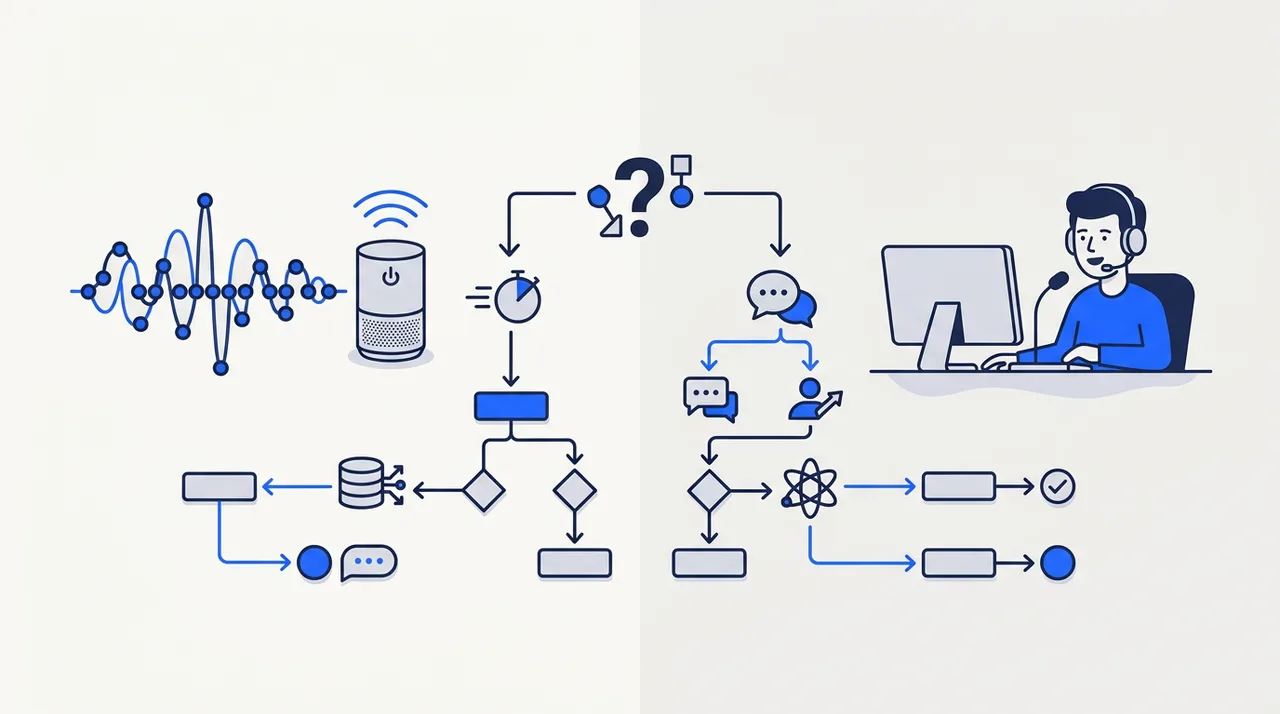
Most "AI vs traditional answering service" comparisons are written by vendors selling one or the other, so the result is predictable: AI is either the obvious future or an over-hyped chatbot that cannot really hold a conversation. Neither framing matches what deployments actually look like. In 2026 the answer is usually neither pure-AI nor pure-human. It is a hybrid where AI picks up every call in under two seconds, resolves 60–75% of them, and escalates the rest to a human within the same call.
The piece below lays the comparison out plainly. Cost math you can verify, an honest read on where AI breaks today, where traditional answering services still win, why hybrid quietly became the default, and a sharp distinction the top SERP results skip: internal hybrid (AI + your own staff) vs external hybrid (AI + a bundled human escalation service). One usually wins for small businesses, the other for larger operations. Plus a decision tree, a real switching-cost timeline if you are moving off Ruby or AnswerConnect, and a five-year projection.
We are a done-for-you AI voice agents shop and recommend traditional or hybrid for plenty of cases. The recommendation here is honestly drawn.
A near-cousin question, AI receptionist vs your own in-house front-desk person, is covered in our AI receptionist vs human receptionist article. This guide is about the third-party answering-service business, not the in-office hire.
The two categories, plainly
Traditional answering service. A third-party call-center business (Ruby Receptionist, AnswerConnect, Specialty Answering Service, Moneypenny, Davinci, PATLive, MAP Communications, Posh, ReceptionHQ) where real humans, usually in a US or near-shore call center, pick up your phone line and follow a script you agreed on. Founded as a category in the 1980s for after-hours and overflow; matured into 24/7 full-service receptionist replacements. Pricing is per-minute, typically $0.80 to $2.50 per minute live-handled, or per-month bundles like Ruby's roughly $235/mo for 50 minutes.
AI answering service. A software vendor (CallCow, Vida, NextPhone, SIMBA Voice, Trillet, CloudTalk, MyAIFrontDesk, Dialzara, Goodcall, WithAllo, plus dozens more) where a trained voice agent picks up the call. The agent does scripted intake, booking, FAQ, qualification, and routes to a human only when it has to. Pricing is per-minute too, but at $0.05 to $0.15 per minute, one to two orders of magnitude cheaper at the unit-cost line. The 2026 versions pass the "I called the number and didn't realize" test for the first 60 seconds of a typical call.
Hybrid AI + human. A growing third category: services or stacks where AI picks up first, handles what it can, and live-transfers to a human in the same call for anything beyond the AI's scope. Smith.ai's offering is the best-known commercial version; an in-house equivalent is "AI receptionist + your staff as the escalation". Pricing typically lands between AI and traditional ($1 to $4 per resolved call equivalent) but the operating model is different from both.
Cost: the like-for-like comparison
The cost gap is the headline. Let's price 500 inbound calls a month averaging 3 minutes each, a typical small-business volume.
| Setup | Monthly cost at 500 calls × 3 min |
|---|---|
| Traditional answering service ($0.80–$2.50/min live) | $1,200 – $3,750 |
| Hybrid AI + human (~$1 per AI-resolved call + $1.50/min on human escalations) | $450 – $900 depending on escalation rate |
| Pure AI answering service ($0.05–$0.15/min) | $75 – $225 |
| In-house receptionist (1 FTE part-time at $20/hr, 20 hrs/wk, 4 weeks) | $1,600 (no after-hours coverage) |
The gap is real. AI is 5x to 50x cheaper than the equivalent traditional service at the per-minute line. Whether the cost difference is worth what you give up is the rest of this article.
For deeper price math see our AI receptionist cost breakdown, the same analysis applied to receptionist tiers.
What AI still does worse than a human in 2026
Honest list. Not the marketing-page version.
- Complex multi-step routing across departments. A caller who needs to be moved from intake to billing to a specific clinician's voicemail based on what they say mid-call still confuses most AI agents. They either over-route (transfer to the wrong place) or freeze (re-ask the same clarifying question twice).
- Emotional crisis or distressed callers. AI tone calibration has improved but still sounds canned under real distress. A grieving caller, a patient in mental-health crisis, an owner whose pet just died: these calls need a human first, not a triage script. We covered the equivalent in AI receptionist for therapy clinics, where the same "always-human" rule applies for anything that touches grief or acute distress.
- Multi-party calls (3+ people on the line). Conference-call setups, spousal joint calls about a parent's appointment, family triage. AI handles one voice well; it loses the thread when two or three voices interleave.
- Heavy accents in noisy environments. A strong regional accent on a landline is fine. The same accent on a cellphone speakerphone in a moving truck is where AI transcription errors stack up. Misheard names, mis-booked appointments, follow-up irritation.
- Long discovery conversations. A consultative call where the caller wants to think out loud for 15 minutes about which service fits. This is a human conversation, not an intake form. AI books a slot fine; it does not hold the consultative talk.
- Genuinely angry callers. Not minor frustration. Anger that demands a real apology and de-escalation. A human can match the emotional weight; the AI sounds tone-deaf.
- Caller who insists on a human. "Is this a person?" If your AI says "I'm an AI assistant, let me get you to someone right now," fine. If it tries to keep the call, you lose the caller and probably the relationship.
That is the working list of AI blind spots in 2026. None are "AI is bad at calls." All are "for these specific call shapes, a human is better." Everything else (bookings, FAQs, hours, intake forms, prescription-refill status, lead qualification, address confirmations, callback requests, payment status) AI handles as well as or better than a typical answering-service operator.
What traditional answering services still do better
The honest reciprocal, in order of how often it matters:
- Warm human voice at first contact, all the time, even at 3 AM. For some high-end brands (legal, concierge, luxury services), this is non-negotiable.
- Real judgment on edge cases. AI is bounded by its script. A trained human operator can decide that this particular caller needs to be put through to the owner's cell despite the script saying "take a message."
- Complex message-taking with nuance. Capturing why a caller is upset, not just what they said. AI captures content well; humans capture context.
- Industries where AI feels off-brand. Funeral homes, hospice, high-end residential real estate, white-glove client services. The signal you send by having a person answer matters more than the cost savings.
- Regulated verticals where the answering service is the legal receptionist of record. Specific to medical and legal: some state-bar and state-medical-board rules treat a documented human chain more favorably for liability purposes.
For most other businesses the things humans do better are real but narrower than the marketing copy implies.
Why hybrid quietly became the default in 2026
The hybrid model is the answer to the cost-vs-quality tension. Architecturally:
- AI picks up every call, under 2 seconds, every time.
- AI handles the call as far as the script and its capability allow. For a typical small business that is 60–75% of inbound: booking, FAQ, intake, routing.
- AI escalates to a human when it hits a defined trigger: caller asks for a human, AI fails to understand twice, conversation enters a regulated topic, caller mentions a crisis keyword. The transfer happens in-call, with full context handed to the human.
Here is the split most SERP results gloss: there are two ways to structure this, and they have very different cost shapes for a small business.
Internal hybrid (AI + your own staff as escalation)
Deploy an AI receptionist (SaaS or custom-built) and define your existing staff (front desk, office manager, owner) as the escalation target. The AI handles routine; the human handles the 25–40% that needs a person.
- Cost: ~$75–$225/mo for the AI + your existing salary expense (no new hire).
- Best fit: any small business that already has at least one front-desk person during business hours.
- After-hours: AI alone or AI + your own on-call.
- Why it wins: you don't pay for human availability you already have.
External hybrid (AI + a bundled human escalation service)
Use a service that bundles both. Smith.ai is the best-known. AI front line, escalation handled by the vendor's human bench, you pay one bill.
- Cost: $235–$700/mo at small-business volumes.
- Best fit: businesses without an existing front-desk human, or with irregular hours / 24/7 coverage needs the existing staff cannot meet.
- After-hours: included.
- Why it wins: true 24/7 coverage without paying your own staff overnight rates.
The SERP results pushing "hybrid is the answer" almost always mean external hybrid (because that is what the writing vendor sells). For most small businesses with an existing front desk, internal hybrid is cheaper and usually more aligned with your operation: your staff already knows your business. Only when you specifically need 24/7 coverage or you have no front-desk person at all does external hybrid win on cost.
At 500 calls/mo with a 30% escalation rate on internal hybrid, you are looking at roughly $200/mo for the AI plus whatever your existing front-desk salary already covers. External hybrid at the same volume runs $500–$800/mo all-in.
Where AI alone is the right call
Some operations do not need any hybrid layer. AI alone is the right answer when:
- Volume is low enough that one-off complex calls can wait for you to call back personally. A 40-call-a-week practice does not need a 24/7 human bench.
- Call shape is predictable. Most calls are bookings, FAQ, refills. The 10% of complex calls can voicemail to you directly.
- Cost is the binding constraint. A new business with thin margins that just needs the phone answered cleanly.
- You are comfortable having the AI offer a callback instead of a live transfer when it cannot help.
Verticals where pure AI tends to work well without hybrid: home services (plumbers, HVAC, electricians; see our home services landing), most independent service businesses, ecommerce phone lines (where most calls are order status or returns), real estate showing scheduling, dental and routine medical appointment booking.
Where traditional alone is the right call
Pure-human still wins when:
- Every call matters as a brand signal. Concierge, white-glove, ultra-luxury, very small high-touch B2B.
- Verticals where the answering service is the de facto practice receptionist and your state bar / medical board has written expectations on documentation chain. Talk to your compliance counsel, not us, before changing this.
- Call mix is dominated by long, consultative conversations. A specialty consultant who gets 15 calls a week and each one is a 30-minute discovery does not gain much from AI deflection.
- You have actively tried AI and decided the brand cost outweighs the savings. Real assessment, not hypothetical objection.
Decision tree
A clean way to match your operation to the right shape, anchored on call mix and existing staff, not just volume or budget:
| If most of the following are true | Recommended shape |
|---|---|
| Predictable call mix (booking, FAQ, intake) • Cost-sensitive • Under 600 calls/mo • You're OK with callbacks on the 10% AI can't handle • Solo or one-person operation | Pure AI answering service |
| Mixed call shape • You already have a front-desk person during business hours • Need after-hours coverage too | Internal hybrid (AI + your own staff) |
| Mixed call shape • No existing front desk OR need true 24/7 human coverage • Brand image matters but isn't ultra-luxury | External hybrid (AI + bundled human service) |
| Concierge / high-touch / luxury / heavily regulated • Long consultative calls dominate • Brand-on-every-call is non-negotiable | Traditional (human-only) |
| Front-desk human already covers business hours • Inbound after-hours is mostly voicemail-worthy | Existing staff + AI/voicemail after-hours |
Most small businesses end up in rows 1, 2, or 5. Row 3 is real but narrower than the SERP listicles imply; row 4 is genuine but narrower still.
For the broader question of whether to hire a human receptionist at all versus deploying AI, see our AI receptionist vs human receptionist article. If you don't know whether you're losing meaningful money on missed calls, the missed-call cost breakdown is the first thing to read. It puts a number on the problem and tells you whether the answering-service question is worth solving for your business.
Switching costs and migration paths
If you're already paying a traditional answering service and thinking about moving to AI or hybrid, the operator-honest version that nobody in the top SERP results publishes:
- The realistic timeline is 4 to 8 weeks, not "live next week." Script transfer, phone-number porting (or call-forwarding setup), CRM integration testing, soft-launch with a small percentage of calls.
- Run both in parallel for at least two weeks. Forward a percentage of calls to AI; keep the rest with the existing service. Measure outcome on bookings, escalations, and complaint rate.
- The contract is usually the biggest friction. Traditional services often have 90-day notice clauses. Read your contract before signing anything new.
- Number porting takes 5 to 10 business days if your AI vendor needs to host the number. If you keep the number on your existing PBX and just forward to the AI vendor, it is same-day.
- The first month with AI typically shows a higher escalation rate than steady state. Plan for 35–45% escalation in week 1, drifting down to 25–30% by week 4 as the script gets tuned to your actual call mix.
Cost over time — five-year view
The unit-cost gap stays roughly stable. What changes over five years:
- AI quality keeps rising (better voices, better understanding, better integrations). Hybrid's escalation rate at the same business is likely to drop from 30% in 2026 to 15% by 2028.
- Traditional service pricing has been rising roughly 3–6%/yr as US labor costs rise.
- Hybrid blended cost is flat to mildly declining.
- Switching costs are real. Anchor your decision in 2026 reality, not retroactively in 2028 reality.
Honest recommendation
If you don't know which row of the decision tree you are in, the defaults that work for most small businesses we see:
- Service business with predictable call mix and an existing front desk: internal hybrid. AI handles bookings and FAQs; your front-desk person handles escalations during business hours; AI handles after-hours. Total ~$100–$225/mo on top of staff you already pay.
- Solo operator or business with no front desk: pure AI for business hours, callback offer for the 10% AI cannot handle. Add external hybrid only when missed-complex-call rate becomes painful.
- Medical, legal, or other regulated: external hybrid by default. Pure AI carries compliance edges that aren't worth saving $200/mo over.
- Concierge or ultra-luxury: stay with traditional. Or put AI on voicemail backup only (every after-hours call going to AI is better than voicemail), but don't make AI the primary voice.
- Already paying $400+/mo to a traditional service for under 200 calls a month: you're overpaying. Internal hybrid usually halves the cost with no loss in caller experience.
We build the AI side of all five scenarios. The honest call across our client base is internal hybrid for most small businesses with an existing front desk, pure AI for solo operators and cost-sensitive operations, and traditional for the brands where it really matters.
FAQ
Is AI answering service cheaper than traditional? Yes, by a factor of 5 to 50 at the per-minute line. At 500 calls × 3 min, traditional runs $1,200–$3,750/mo while pure AI runs $75–$225/mo. Hybrid lands in the middle ($450–$900/mo for external hybrid; closer to $100–$225/mo plus existing staff cost for internal hybrid). For most small businesses with an existing front desk, internal hybrid is the cheapest sufficient answer.
Can AI really handle warm transfers and live escalation? Yes, with caveats. Modern AI receptionists can warm-transfer to a defined phone number or to a human operator in a hybrid setup, handing over the caller's name, reason for calling, and a brief transcript. Cold transfers without context are easier and more universally supported. Vendors vary; ask for a live demo of the escalation flow before signing.
Does AI answering service work for after-hours? This is one of its strongest cases. AI does not sleep, does not get tired, costs the same at 3 AM as at 3 PM. For after-hours coverage, AI-only often beats hybrid (since the human side of hybrid usually charges overnight premium rates).
What is the catch with the cheaper AI services? At the very bottom of the price range ($0.05/min), the catches are usually: lower-quality voice (still recognizably synthetic), limited integrations (calendar-only, no CRM write-back), strict minute caps, no warm-transfer support, no BAA or compliance attestations, and limited or no after-hours support. The $0.10–$0.15/min range is where serious small-business AI services sit.
Should I switch from Ruby or AnswerConnect to AI? Likely yes if you are paying $400+/mo for under 200 calls and your call mix is routine. Likely no if your brand depends on a human voice at first contact, or you are in a regulated vertical where the answering service is your documented receptionist. The internal hybrid is the safest middle path: add an AI front line, keep your existing front desk as escalation, see how the escalation rate trends over 90 days.
What about callers who hate talking to a bot? Two things: (1) modern AI voices in 2026 pass the "didn't realize" test for the first 60+ seconds on a typical call, so the bot-hate trigger fires less than it did in 2023; (2) any caller who explicitly asks for a human should be transferred immediately, no resistance. Vendors that respect this lose fewer callers than those that try to keep the AI on the line.
How do I evaluate which AI vendor to pick? Run a 2-week parallel test. Forward 10–25% of your calls to the AI vendor; measure bookings made, no-show rate, escalation rate, and caller-satisfaction proxies (callback rates, complaint rates). Don't pick on demo quality alone. The demo is the vendor's best case.
If you are stuck between pure AI, internal hybrid, external hybrid, and traditional and want a real read on which fits your call mix, book an intro call. We build AI voice agents end-to-end and will tell you honestly when sticking with your existing answering service is the right call for your operation.
Already decided AI or hybrid is the direction, and now comparing specific options? See our breakdown of automated answering services for small business, which inventories the live/AI-SaaS/hybrid/custom-build options directly rather than making the AI-vs-traditional case.