AI Receptionist vs. Human Receptionist
AI receptionist vs. human receptionist: an honest US comparison of real cost, coverage, and consistency — and a straight verdict on which to choose.
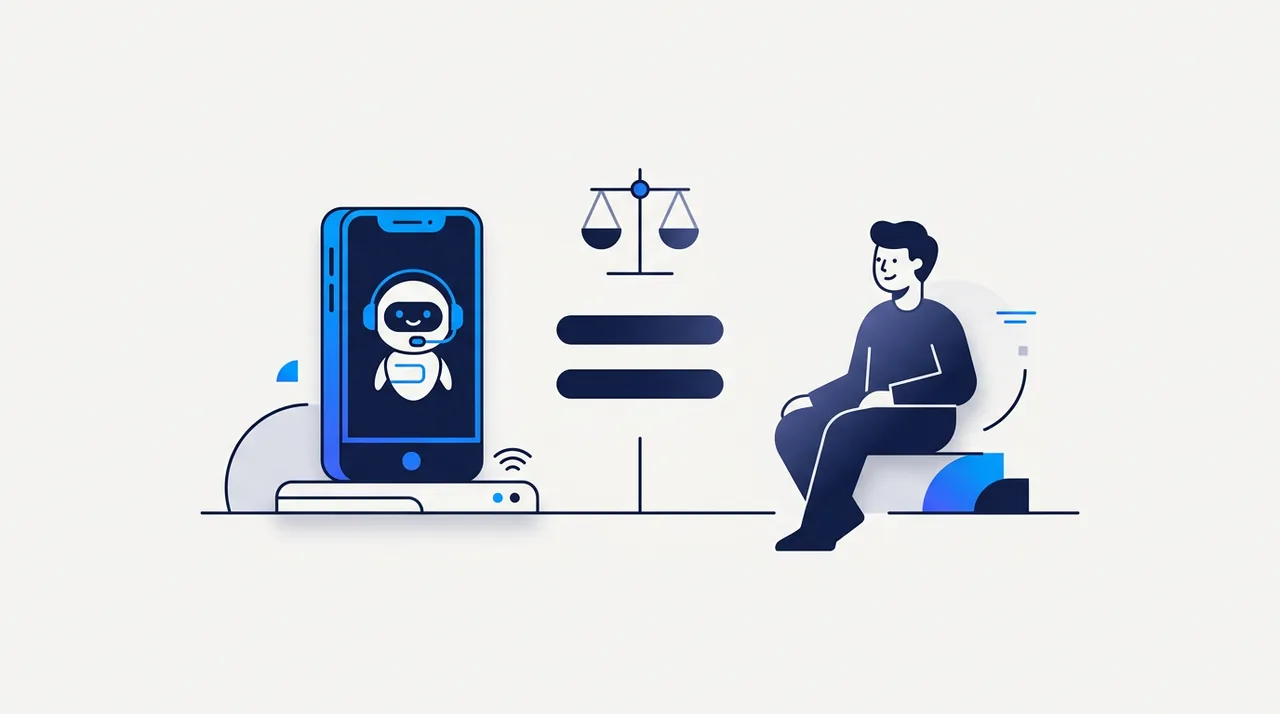
If your phone rings more than your team can answer, you have probably weighed two fixes: hire a receptionist, or hand the phone to an AI voice agent. The honest answer for most US small businesses is not one or the other. It is both, with the AI carrying the routine, after-hours, and overflow volume, and a person kept for the calls that genuinely need judgment. This comparison of an AI receptionist vs. a human receptionist walks through what each one actually costs and covers, so you can decide where that line sits for your business.
These are not the same tool, and neither is simply "better." A human is a whole role: front-desk presence, in-person tasks, judgment. An AI voice agent does one job — answer the phone — and does it without gaps. Most of the decision comes down to how much of your problem is the phone.
The short answer
For most small businesses, an AI receptionist wins on cost, coverage, and consistency, and a human still wins on empathy and judgment. If you have no receptionist today, an AI voice agent is the cheaper, faster first step. If you already have a receptionist who is drowning in interrupted calls, the better move is to add AI on overflow and after-hours rather than replace the person. The rest of this article is the math and the trade-offs behind that.
Cost: what each option really costs in the US
Most comparisons quote a salary and stop there. The salary is the smallest honest part of the number.
A receptionist's pay is the visible cost. The U.S. Bureau of Labor Statistics put the median receptionist wage at roughly $17.90 an hour in its May 2024 data — about $37,000 a year for a full-time seat. On top of that sits the part owners forget:
- Payroll tax, benefits, and paid time off — typically adds a meaningful percentage on top of base pay.
- Recruiting and training — the weeks before a new hire is useful, plus your time spent hiring.
- Turnover — front-desk roles turn over often, and each departure restarts the recruiting-and-training cost.
- The coverage ceiling — one person answers one call at a time, during set hours. Two calls at once, lunch, or a sick day are gaps no single hire closes.
An AI voice agent is priced differently: a monthly subscription, or a one-time done-for-you build with a smaller running cost, depending on the setup. There is no payroll tax, no benefits, no turnover, and no recruiting gap. For a precise breakdown of the AI side, see what an AI receptionist costs — it covers the three pricing models in detail.
The honest caveat: a hire buys more than call answering. If you also need someone to greet walk-ins, handle mail, and manage a front desk in person, an AI agent does not replace that — it only replaces the phone part. Compare like for like. If the phone is the actual problem, the AI is far cheaper. If you need a physical front desk, that is a different purchase.
Coverage: hours, overflow, and simultaneous calls
A human receptionist works set hours. Nights, weekends, lunch breaks, sick days, and the moment two calls arrive at once are all gaps — and a caller who hits a gap usually calls a competitor instead of leaving a message. That lost call rarely shows up on any report, which is why owners underestimate it. We covered how to put a dollar figure on it in what missed calls cost your small business.
An AI voice agent answers every call instantly, around the clock, and handles unlimited calls at the same time. There is no hold queue and no after-hours voicemail. For raw coverage, the comparison is not close — the AI wins clearly, and it wins hardest on the after-hours and overflow calls a single hire was never going to catch.
Consistency and records
A person has good days and bad days. An AI agent runs the same script on every call: it never forgets to ask for insurance details, never skips the qualifying question, and never sounds rushed at 5pm on a Friday. Every call ends with a clean, structured summary you can actually act on.
The honest counter: a script is only as good as how it was built. A badly configured AI is consistently mediocre — it will reliably ask the wrong questions or mishandle the same edge case every time. Consistency is a strength only when the underlying setup is right. That is the part of the job that takes real work, and it is why how the agent is built matters more than which vendor's logo is on it. If you want the mechanics, how an AI receptionist works walks through it in plain English.
The human touch: where a person still wins
This is where a person still matters, and where most AI-vendor comparisons quietly look away.
A genuinely upset caller, a delicate or unusual situation, a conversation that needs empathy and judgment — a good human receptionist handles these in a way an AI should not try to. An AI that attempts to emote its way through a distressed caller usually makes the call worse. The right design is not for the AI to fake warmth; it is for the AI to recognize those calls early and hand them to a person cleanly, with the context already gathered.
So the human wins here plainly: emotional, high-stakes, relationship-heavy, or genuinely unusual calls belong with a person. A small business with a client base built on personal relationships should weight this heavily.
What the caller actually experiences
Strip away the vendor framing and ask what the caller wants. It is the same in both cases: answered fast, understood, and moved forward — booked, answered, or routed to the right person.
A good AI agent delivers that with instant pickup, no hold music, and no "let me check and call you back." A bad AI agent mishears, loops the caller, or cannot escape its script — and the caller can tell. A good human delivers warmth and judgment a script cannot. A human on a second line, or having a bad day, delivers hold music or voicemail — and the caller can tell that too.
The point: "AI vs. human" is not the real question for the caller. "Answered well vs. not answered" is. Both options can clear that bar; both can fail it. Coverage decides how often the call gets answered at all, and that is where the AI's edge is structural.
So which should you choose? A straight verdict by situation
The decision is less about AI vs. human in the abstract and more about your situation.
- No receptionist today. An AI voice agent is the obvious first step — full coverage at a fraction of the cost of a hire, and you can add a person later if in-person needs grow.
- A receptionist who is drowning. Do not replace the person. Put the AI on overflow, after-hours, and weekends. Your receptionist stops fielding constant interruptions and keeps the calls that need a human. This is the most common winning setup.
- Low call volume, mostly in-person, calls already getting answered. You may not need either yet. If almost every call is reaching a person and few are new customers, the math may say do nothing — and that is a legitimate answer.
That middle case is how the businesses in our case studies use it — a dental practice, a law firm, and a real-estate team each kept their people and added an AI agent to catch what was slipping through after hours and during the rush.
The bottom line
A human receptionist brings judgment and empathy. An AI receptionist brings coverage, cost, and consistency. The mistake is treating it as a contest between people and technology. The businesses that win use the AI so no call is ever missed, and keep their people for the calls that need a person.
Want to know which setup fits your business? Book a free call — we will give you a straight answer, even if that answer is "you do not need this yet."
Frequently asked questions
Can an AI receptionist fully replace a human receptionist? For the phone, often yes — an AI voice agent can answer, book, qualify, and route calls without gaps. For a full front-desk role that includes greeting walk-ins and in-person tasks, no. Match the tool to the actual job: if the problem is the phone, the AI replaces it; if you need a physical front desk, you still need a person there.
Will callers know they are talking to an AI? A well-built AI voice agent sounds natural and gets the caller booked or answered quickly, which is what they care about. Some callers will notice, some will not. What matters more is that the call is answered instantly and handled well — an unanswered call and a voicemail are a far worse experience than a competent AI.
Is an AI receptionist worth it for a very small business? It depends on how many calls you miss and how much a new customer is worth. If you regularly miss new-customer calls after hours or during busy periods, the lost revenue usually dwarfs the cost of an AI agent. If you rarely miss calls, it may not be worth it yet — estimate first.
Can I use both an AI and a human receptionist? Yes, and for many small businesses that is the best setup. The AI takes overflow, after-hours, and weekend calls; the human handles the in-person work and the calls that need judgment. You get full coverage without asking one person to be in two places at once.