AI Voice Agent in Healthcare: A Buyer Framework
How AI voice agents work in healthcare: use cases beyond scheduling, an independent evaluation framework, and build-vs-buy guidance for groups.
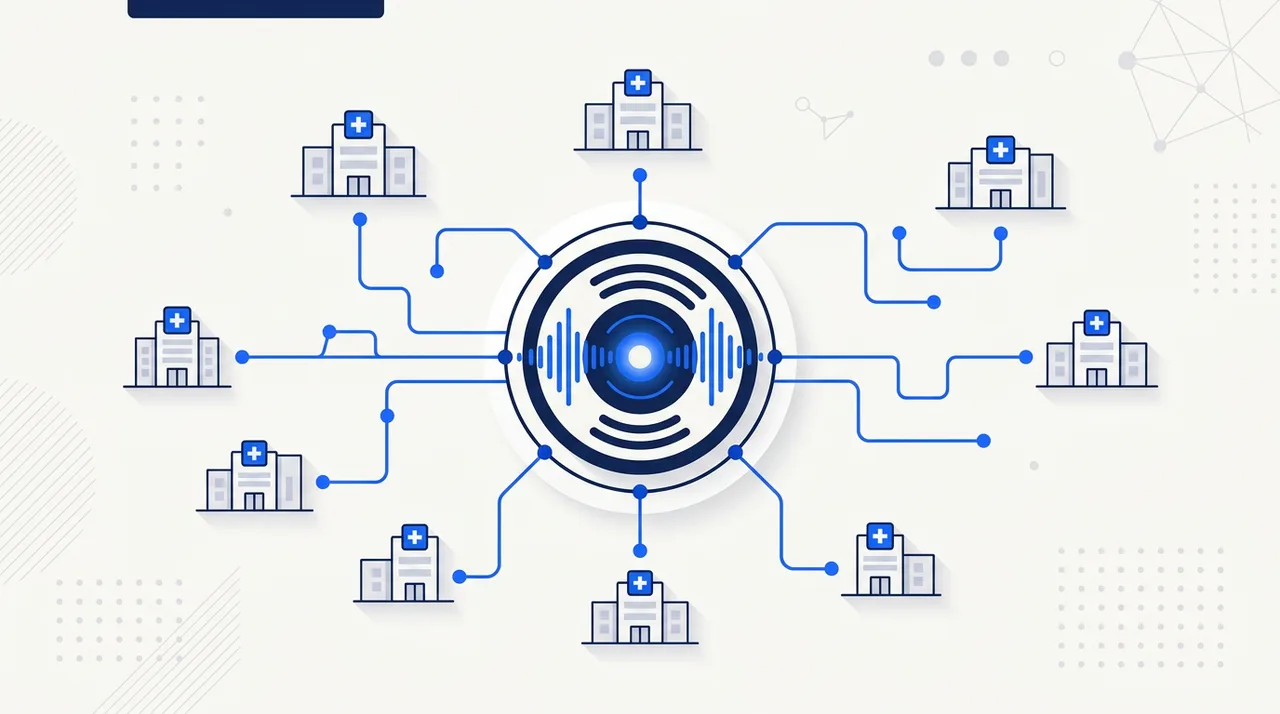
Every piece ranking for "AI voice agent in healthcare" right now was written by a vendor selling one, and three of the largest name themselves the top pick inside their own comparison table. That's not dishonest so much as structurally incapable of being neutral. This piece is written by an agency that builds these systems rather than sells one platform, aimed specifically at the buyer nobody else in the search results is writing for: a multi-location healthcare group, not a single practice and not a hospital system with a procurement department.
If you run a single practice and want the HIPAA and PHI mechanics in full, our AI receptionist for medical office guide covers the compliance chain in depth. If you're already shopping and want named tools compared on EHR write-back and pricing, our best voice AI for patient intake calls guide does that comparison honestly, TendForce included at the bottom of the list. This piece sits above both: it's the framework for a group running more than one location trying to figure out what an AI voice agent actually is, what it should cover beyond the front desk, and how to evaluate one without a vendor doing the evaluating for you.
What "AI voice agent in healthcare" covers
An AI voice agent in a healthcare context is a phone-based system that holds a real conversation with a caller (patient, caregiver, or payor representative), rather than routing them through a touch-tone menu. It answers, understands what the caller needs, retrieves or updates information in the practice's systems, and either resolves the call or hands it to a person with the right context already captured.
For a multi-location group (an urgent care chain with six sites, a dental or orthodontic DSO managing a dozen acquired practices, a multi-site specialty group), that definition matters more than it does for a single office, because the same phone system now has to work identically across locations with different hours, different providers, and often different practice-management systems left over from each acquisition.
Two things this piece deliberately does not do. It doesn't rank named vendors against each other; that comparison already exists, done honestly, in the patient-intake guide linked above. And it doesn't re-walk the PHI-compliance chain field by field; that's a full guide on its own, linked above as well. What it does instead is answer the question a multi-location operator needs answered before either of those documents becomes useful: what should this system be doing across our locations, and how do we evaluate a fit for that, independent of what any single vendor tells us.
The patient-communication map beyond scheduling and intake
Every article ranking for this keyword frames AI voice agents around scheduling and intake: booking, rescheduling, insurance capture, referral routing. This is real, and it's the highest-volume call type at most front desks. It's also not the whole job, and the gap matters more for a multi-location group than a single office because the missed volume scales with every site added.
Post-discharge and follow-up calls. A patient discharged from an urgent care visit or a specialist procedure needs a check-in call: how are you feeling, did you fill the prescription, do you need a follow-up scheduled. Done manually, this call happens inconsistently across a multi-site group, since it depends on whichever front-desk staffer has time that day. An AI voice agent that places this call on a fixed schedule (24 hours post-visit, 7 days post-procedure) turns an inconsistent courtesy into a standard operating procedure across every location.
Medication adherence reminders. For chronic-condition management across a multi-site specialty group, refill reminders and adherence check-ins are high-volume, low-complexity, and easy to standardize once a call flow is built once and deployed everywhere. The complexity is naming the medication and confirming refill status, not giving clinical advice; the AI's job stops at "have you been taking X as prescribed" and routes anything beyond that to a clinician.
Payor and benefit verification calls. Outbound calls to insurance payors to verify eligibility or benefit details are a real, high-friction task that most front-desk staff dread and deprioritize. An AI agent placing these calls (and, increasingly, receiving structured responses from payors that have their own automated systems) removes a task that otherwise waits in a queue behind higher-priority patient calls.
Revenue-cycle calls. Balance-due reminders, payment-plan setup calls, and pre-visit cost-estimate calls sit in the same bucket: necessary, unpleasant for staff to prioritize, and standardizable once a group decides on the script and escalation rules.
None of the eight vendor pages currently ranking cover this full map in one place. Most stop at scheduling and intake because that's the highest-visibility use case and the easiest one to demo. A multi-location group evaluating an AI voice agent should ask upfront which of these four categories a platform handles in production today, not which ones are "on the roadmap."
To make the post-discharge case concrete: a well-scoped call opens with the AI confirming who it's speaking with and why it's calling ("This is a courtesy follow-up from [clinic] after your visit yesterday"), asks one or two open questions about symptoms or medication pickup, and closes with a clear next step, either "we'll see you at your follow-up on [date]" or an escalation trigger. The escalation trigger matters most: specific answers (chest pain, difficulty breathing, a fever above a threshold the clinical team sets) route immediately to a live nurse line rather than waiting for the call to finish. A vendor that can't describe this trigger list in specific terms during a sales call hasn't built it yet; they've built a generic check-in script and are calling it clinical follow-up.
Not every category is equally mature yet
The four categories above aren't equally mature in what's commercially available today. Scheduling and intake are the most built-out; most platforms handle them competently. Post-discharge follow-up and medication adherence are handled well by a smaller number of platforms, usually the ones with an explicit clinical-safety layer rather than a generic conversational AI repurposed for healthcare. Payor and revenue-cycle calls are the least mature category across the market broadly, since they require the AI agent to work through another organization's own phone tree or API rather than just receiving an inbound call.
That maturity gradient matters for sequencing. A group standing up its first AI voice agent deployment should not expect to launch all four categories simultaneously. The realistic sequence starts with the highest-volume, best-understood category (scheduling and intake), proves out escalation and reporting at one or two locations, and only then expands to the categories that require more clinical-safety configuration or more complex integration work.
An independent framework for evaluating AI voice agents
Three of the platforms ranking for this exact keyword rank themselves first in their own comparison content. That's a reasonable thing for a vendor to do and a reason not to use a vendor's own evaluation criteria as your evaluation criteria. Here's a framework built around what breaks a multi-location deployment in practice, not what a single vendor wants weighted highest.
Consistency across locations. Does the platform support one call-flow configuration deployed identically across every site, with per-site overrides only where genuinely needed (different hours, different provider names, different local phone numbers)? A platform built for a single practice often makes multi-site deployment an afterthought, requiring a separate configuration built from scratch at each location.
EHR and practice-management variance. A DSO or multi-site group frequently inherits a different EHR or PM system at each acquired location, at least until a migration project consolidates them. Ask specifically whether the platform's integration depth holds across every system your group runs today, not just the flagship one in the vendor's case studies.
Escalation consistency. When the AI can't resolve a call, does it escalate the same way at every location (same-line transfer, callback, or message), or does escalation depend on which local staff happen to be reachable? Inconsistent escalation is invisible until a caller at your newest, least-staffed location gets a materially worse experience than one at your flagship site.
Centralized reporting with per-site visibility. A group operator needs to see call volume, resolution rate, and escalation rate both in aggregate and broken out by location, to catch a single site quietly underperforming before it shows up in patient complaints.
Real BAA coverage, not a marketing claim. Every platform in this space says "HIPAA-compliant." The actual question, covered in full in our medical-office guide, is whether every layer of the call path (telephony, speech-to-text, the language model itself, text-to-speech, storage) is covered by a signed Business Associate Agreement, not just the vendor's own front-end.
Language and accessibility coverage. A multi-location group serving a diverse patient population needs to know upfront which languages a platform handles at production quality, not just "multilingual support" on a features page, and whether an accessibility accommodation (a caller who needs extra time, or a caregiver calling on a patient's behalf) is something the call flow was designed around or something that breaks the script.
A real pilot path. A platform that insists on a full-group rollout before you've tested it at one location is asking a multi-location group to make a decision with location-one data multiplied by a guess. The right sequence, covered below, is one or two locations first, measured against the criteria above, before a group-wide commitment.
Where PHI compliance fits (and where to go deeper)
Every call a voice agent in healthcare touches involves Protected Health Information the moment a caller says a name and a reason for calling, whether the call is a scheduling request, a medication check-in, or a payor verification call. The compliance obligation doesn't change based on which of the four use-case categories above the call falls into.
What changes for a multi-location group is scale: a compliance gap at one location (an ASR provider without a signed BAA, an analytics dashboard hosted somewhere it shouldn't be) is a gap at every location running the same stack, not an isolated incident. Our medical-office guide walks through the full PHI flow across six layers of a typical call and names which vendors sign BAAs through which contract path. That detail doesn't repeat well here; the operative point for a multi-location group is to verify the BAA chain once, at the platform level, rather than location by location.
What's different about a multi-location deployment
The single biggest practical difference between deploying an AI voice agent at one practice and deploying one across a group is that a single-location build tolerates a certain amount of manual configuration and cleanup that doesn't scale.
Per-site customization that isn't actually per-site. A dental DSO with twelve locations doesn't need twelve different call flows. It needs one call flow with a small number of genuine variables (hours, provider names, local number) and a process for adding a thirteenth location without rebuilding the system from scratch. Platforms built for single-practice deployment often don't have this distinction built in, and a group finds out only after the second location takes as long to configure as the first did.
Inherited EHR sprawl. Acquisitions bring inherited systems. A group that has acquired practices running Dentrix, Open Dental, and Eaglesoft simultaneously needs a voice-agent platform (or a custom integration layer) that can write back to all three, or an explicit plan for which locations get real-time write-back now versus after a planned EHR consolidation.
Local number and routing continuity. Patients call the number they've always called. A group-wide deployment needs each location's existing number preserved and routed into the new system, not a single new group-wide number that confuses returning patients or breaks referral tracking tied to a specific location's line.
Staffing model differences across sites. A flagship location with a full front-desk team escalates differently than a newly opened or short-staffed site. The AI voice agent's escalation logic needs to account for which sites have a live human available during which hours, rather than assuming uniform staffing everywhere.
Failure modes that show up specifically at multi-location scale
Some problems only surface once a deployment spans more than one site, because a single-location pilot doesn't have the variance to expose them.
The pilot location isn't representative. A group tests the AI voice agent at its flagship, best-staffed, best-documented location, sees strong results, and rolls out group-wide, only to find the newest or most under-resourced location has messier scheduling rules and inconsistent provider data that the pilot never exercised. Pick a pilot location with average, not best-case, data quality.
Configuration drift across locations. Without a single source of truth for the call-flow configuration, small differences accumulate: one location's staff adjusts the escalation script locally, another's provider list goes stale after a hire, and six months in, no two locations are running quite the same system anymore. This needs an explicit ownership model (who updates the shared configuration, and how often) from day one, not after the drift is already a problem.
Reporting that hides underperformance. Aggregate metrics across a group can look healthy while one or two locations quietly underperform. A 90% resolution rate group-wide can mean every location is at 90%, or it can mean eight locations at 95% masking two at 70%. Per-location reporting, not just group averages, is what catches the second case.
Integration debt at acquired locations. A newly acquired practice often arrives with a legacy phone system, a different EHR, and staff unfamiliar with the group's standard workflow. Bringing that location onto the shared AI voice agent deployment takes real integration work every time, and treating it as a checkbox rather than a project is a common source of a rocky launch at the newest site in a group.
Build vs buy for a multi-location group
Most of the self-serve and mid-market platforms compared in our patient-intake guide are built and priced around a single practice or a small number of locations on one EHR. They remain the right starting point for a group testing whether AI voice agents work for their call volume at all, particularly a group of two or three locations on a shared system.
The custom-build conversation becomes relevant at a different point: when the number of locations, the number of distinct EHR/PM systems, or the need for the broader use-case map above (post-discharge, adherence, payor verification, revenue cycle, not just scheduling) outgrows what a single platform's standard configuration supports. That's a smaller, later-stage audience than "any healthcare business shopping for a voice AI," and it's worth being direct about that rather than pitching a custom build as the default answer.
The rough shape of the decision: a group on one EHR across all locations, needing scheduling and intake only, is well served by the tools in the patient-intake comparison. A group spanning multiple EHRs, needing the broader call-type coverage, or needing centralized reporting with per-site breakdowns that no single self-serve platform currently offers cleanly, is the point where a coordinated custom build across locations starts to pay for itself.
How to pilot before a group-wide rollout
Whichever path a group chooses, self-serve or custom, the sequence matters more than the platform choice. Pick one or two locations with average (not best-case) data quality and staffing. Run the highest-volume use case, scheduling and intake, for four to six weeks. Measure resolution rate, escalation accuracy, and patient feedback at that location specifically, not against a vendor's published benchmark from a different practice.
Only after that pilot produces numbers a group is comfortable with should the configuration extend to a third location, ideally one with different characteristics from the pilot sites (a different EHR, a newer or more short-staffed team) to surface the multi-location failure modes above before they show up group-wide. A rollout that skips this step and goes from one location straight to all of them is the single most common way a promising pilot turns into a group-wide headache six months later.
FAQ
What's the difference between this and an AI receptionist for a single medical office? Scale and consistency. A single-office deployment tolerates configuration that doesn't need to repeat. A multi-location deployment needs one call-flow model that works identically (with a small set of real per-site variables) across every location, plus centralized reporting and consistent escalation rules a single-office setup doesn't need to think about.
Is an AI voice agent in healthcare HIPAA compliant? Compliance is a property of the deployment, not the platform. Every layer that processes a call (telephony, speech-to-text, the language model, text-to-speech, storage) needs its own signed Business Associate Agreement for the deployment to be compliant. See our medical-office guide for the full compliance chain and which vendors actually sign at each layer.
Does an AI voice agent replace front-desk staff across a multi-location group? No. It absorbs the routine, high-volume calls (scheduling, refill requests, standard follow-up, benefit verification) so front-desk staff can focus on the calls that need judgment: complex scheduling conflicts, distressed callers, and anything the AI correctly escalates rather than guesses at.
How is pricing different for a multi-location deployment versus a single practice? Self-serve platforms typically price per location or per call volume, which scales roughly linearly with site count. A custom build for a multi-location group is usually scoped once across the full deployment (not per site) with a shared integration layer, which is why the economics shift in favor of a custom build once a group passes a handful of locations with EHR variance.
Which use case should a multi-location group automate first? Scheduling and intake first, since it's the highest call volume and the easiest to measure. Post-discharge follow-up is usually the second addition, since it's high-value and currently inconsistent across most groups. Payor verification and revenue-cycle calls tend to come later, once the group has confidence in the platform's accuracy on lower-stakes calls.
How many locations should be in the initial pilot? One or two, chosen for average rather than best-case data quality and staffing. A pilot at only the flagship location tends to understate the challenges a group will hit once the newest or most short-staffed site comes online.
If you're running more than one healthcare location and the standard self-serve platforms in our patient-intake comparison don't cover your EHR mix or your full call-type map, book an intro call. We build AI voice agents for multi-location groups end-to-end and will tell you honestly if a self-serve platform is still the better fit for your site count.