Best Voice AI for Patient Intake Calls (2026)
Independent buyer's guide to 10 voice AI tools for patient intake calls. EHR matrix, BAA chain, real cost math, and an honest agency disclosure.
Search "best voice AI for automating patient intake calls" and almost every list you find has the same three problems. It was written by a vendor that put itself at number one, the "EHR integration" claims are hand-waved with no per-vendor matrix, and nobody publishes the cost math for the size of practice that's actually shopping.
This guide is different in three ways. It walks through what patient intake actually collects (seven fields, not "scheduling"), it gives you a real EHR/PMS integration matrix, and it discloses its bias plainly: TendForce publishes this article and appears at position 10, last, because we serve a different buyer than the SaaS tools above us. Everything else is described in neutral terms with pricing dated to late May 2026.
What "patient intake" actually means (the 7 fields most buyers skip)
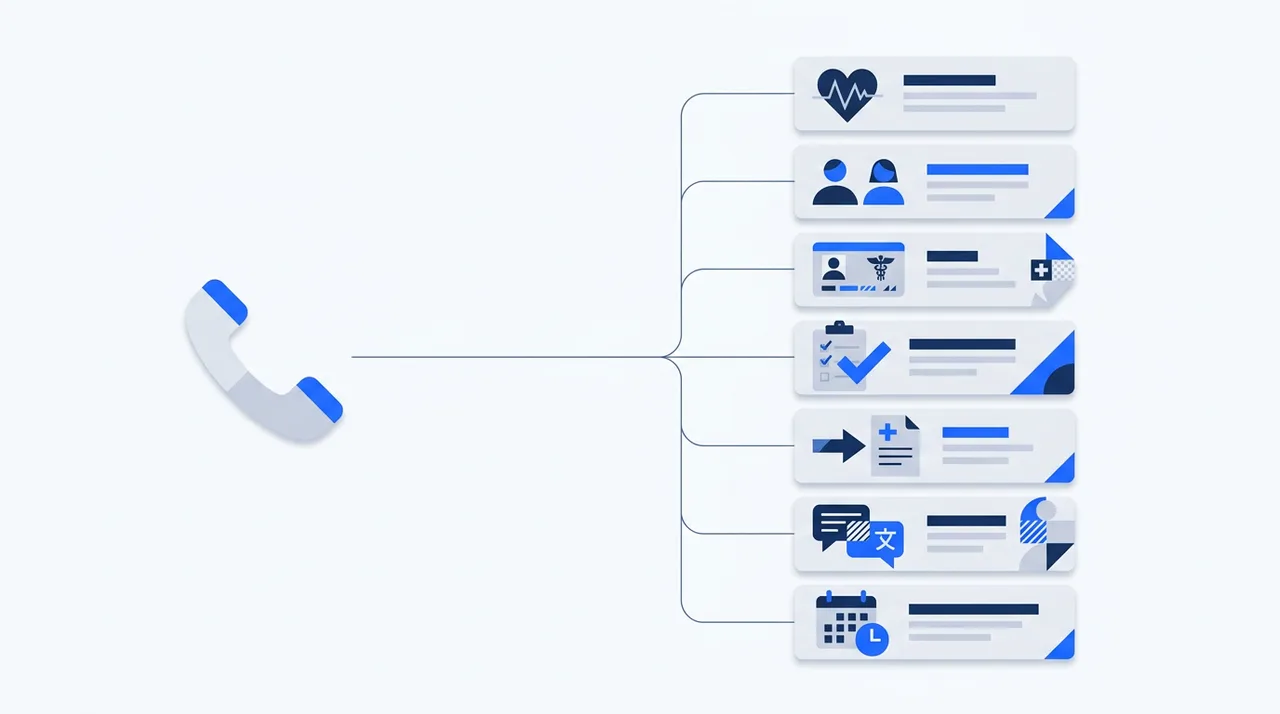
When practice managers ask for "an AI agent that handles patient intake," the request usually collapses into "answer the phone and book a slot." That's appointment scheduling, not intake. Real intake is the seven-field structured handoff between a person dialing your front desk and a complete, payable, routable encounter on your schedule.
Run through the fields a human front desk fills in for a new-patient call:
- Chief complaint — the free-text reason for the visit ("my knee swelled up after I hiked Sunday"). The hardest field for voice AI because it doesn't map cleanly to a dropdown.
- Demographics and date of birth — legal name, DOB, address, phone, email. AI handles this well; verification against existing records is the failure point.
- Insurance verification — payer name, member ID, group number, real-time eligibility check. The split between AI tools that capture insurance and AI tools that verify eligibility live is the largest functional gap in the market.
- Prior authorization status — for specialist visits, is there a referral attached? Was prior auth approved? Most AI tools mark "asked" without confirming.
- Referral source — how the patient heard about you. Trivial, but feeds marketing attribution.
- Language preference and accessibility — preferred spoken language, hearing accommodation, mobility note for the visit. Often skipped entirely by AI tools that ship in English-only.
- Appointment reason → routing logic — which provider, which sub-specialty, which sub-template. Pediatric ortho is not adult ortho, and routing wrong burns the slot.
A four-minute call collects all seven and writes them to the EHR before the patient hangs up. The vendor pages you'll read mostly cover fields 2 and 7 well, fields 3 and 4 partially, and field 1 with optimism. Knowing which field a tool actually owns versus claims to own is the buyer's job, and it's what the rest of this guide tries to make explicit.
How we evaluated 10 voice AI tools for patient intake
The six criteria below are weighted by how often they break a deployment, not by how often they're listed on vendor pages:
- EHR/PMS write-back depth (30%). Real-time write to Epic / Athena / eClinicalWorks / etc., or batch CSV the next morning. This is the difference between intake and call-recording.
- HIPAA-BAA chain coverage (25%). Does the vendor's own BAA cover the full call path — telephony, ASR, LLM, TTS, storage, analytics — or do you assemble BAAs with subprocessors yourself? More on this in the BAA chain section.
- Latency under 800 ms p99 (15%). Above ~800 ms round-trip, the conversation starts to feel like a phone tree. Patients hang up.
- Medical ASR accuracy (15%). Generic speech-to-text adds roughly 8–15 word-error-rate points on medical vocabulary versus general English, per Telnyx's published April 2026 measurement. The vendors that fine-tune on clinical corpora win this row.
- Pricing transparency (10%). Either a number is on the website or "contact sales." Both are valid; opacity is a forecasting risk, not a quality signal.
- Time-to-deploy (5%). Self-serve onboarding versus a 6–10 week implementation. Smaller weight because most buyers care about right answer over fast answer.
A note on disclosure. TendForce is an AI-agent agency, not a SaaS tool, so we put ourselves at the end of the list — not at #1 the way the four articles currently ranking for this query do. If you can self-serve, the nine tools above us are your shortlist. We're for the buyer who wants the build, the BAA chain, and the EHR work done end-to-end by one team.
The 10 best voice AI tools for patient intake calls
1. Prosper AI — healthcare-native, deepest EHR coverage
Prosper AI is the most-cited healthcare voice-AI vendor in the SERP for a reason: 80+ published EHR/PM/payer integrations, including Epic and athenahealth, with 0-day LLM retention and SOC 2 Type II on its own pages. It's the closest thing to a turnkey healthcare-native option for mid-sized groups. Pricing is custom (likely $1,200–$3,000/month based on third-party estimates for comparable specialty volumes) and isn't listed publicly. Best for multi-location practices with mixed EHR estate and a procurement team comfortable negotiating contract pricing.
Key gap: the published case studies favor enterprise-scale outcomes. Small practices (under five physicians) don't get the same case-study coverage.
2. Hyro — Epic-focused enterprise health systems
Hyro is the platform behind the widely-cited Tampa General Hospital deployment: a 56% drop in call abandonment (34% to 14.9%), a 58% drop in average wait time (6.2 to 2.4 minutes), and a 21% lift in appointment completions, per Hyro's published case study and subsequent coverage in Becker's Hospital Review. Hyro's strength is deep Epic integration; the cost is enterprise-grade implementation cycles (3–6 months) and enterprise pricing. Best for hospital networks and large multi-specialty groups already on Epic.
Key gap: not appropriate for sub-50-provider practices on a single PMS like Dentrix or Kareo.
3. Retell AI — developer-first, $0.07/minute pay-as-you-go
Retell AI sits at the opposite end of the spectrum from Prosper and Hyro: a developer-platform priced at $0.07 per minute, with no opinion on what your call flow should look like. You bring your own EHR integration, your own BAA assembly with the LLM and ASR providers, and your own design for the seven intake fields. In exchange you get total control and the lowest per-minute economics in the list. Best for practices with an in-house developer or a partner agency.
Key gap: Retell ships you a toolkit, not a healthcare agent. The BAA chain is your problem to assemble.
4. Assort Health — specialty-trained for derma, ortho, GI
Assort Health is the only vendor in the list that fine-tunes per specialty out of the box. Their published 4.3/5 patient satisfaction score is sampled across tens of thousands of post-call surveys (Assort's public claim, as of early 2026). Pricing starts around $1,500/month per practice, per Assort's published tier. Best for single-specialty groups in dermatology, orthopedics, gastroenterology, or fertility where the intake script genuinely differs from primary care.
Key gap: the specialty-trained advantage shrinks if your specialty isn't on Assort's list yet.
5. CloudTalk — UCaaS phone system with AI receptionist add-on
CloudTalk is a business phone system first ($25–$49 per user per month for the base tier as of late May 2026) and a voice-AI vendor second. The AI receptionist add-on is HIPAA-ready on the higher plans, and the integration story is broad (Salesforce, HubSpot, Zapier-mediated EHR). Best for practices that want their phone system and their AI receptionist from one vendor and don't need real-time EHR write-back.
Key gap: "HIPAA-ready" with a UCaaS provider usually means a BAA on the phone-system layer, not a unified BAA across the full call path.
6. Synthflow — no-code agent builder, $99–$499/month
Synthflow is the no-code builder of the group: drag-and-drop call flows, voice library, calendar integration, with HIPAA available on the Enterprise tier. Pricing is transparent and tiered ($99/month entry, $499 for Pro, custom Enterprise as of late May 2026). Best for an operations lead who wants to build the intake script themselves without writing code.
Key gap: no-code platforms hit a ceiling fast on conditional logic. A three-branch intake flow is easy; a 12-branch insurance-eligibility decision tree is painful.
7. Syllable (ActiumHealth) — developer-friendly, metered
Syllable was acquired by ActiumHealth in 2024 and now sits inside a broader patient-engagement platform. The voice agent is metered, the documentation is real, and the BAA path is workable but requires you to assemble the LLM and ASR subprocessor BAAs separately. Best for health systems already running ActiumHealth's outreach products who want voice intake on the same vendor.
Key gap: as a single-purchase intake tool without the larger ActiumHealth stack, the price-to-value gets thin.
8. EliseAI — multi-channel (voice, SMS, chat)
EliseAI's strength is omnichannel: the same agent handles voice, SMS, and web chat, which matters more for property management (their original vertical) than for medical intake. Healthcare deployment exists but with less published outcome data than Hyro or Prosper. Best for practices that want a single agent across voice + SMS reminders + portal chat and accept that the voice channel is one of three priorities.
Key gap: healthcare-specific case studies are sparser than the multifamily housing case studies that built the company.
9. Zocdoc Zo — for practices already on the Zocdoc marketplace
Zo is Zocdoc's in-platform AI agent. It books inside the Zocdoc ecosystem against your existing Zocdoc availability. If your practice already pays for Zocdoc marketplace listings, Zo is a low-friction add. If you don't, Zo isn't a standalone voice-AI tool you can adopt.
Key gap: lock-in. You're committing to keep using Zocdoc.
10. TendForce — done-for-you build and operations
TendForce is our agency. We don't sell a self-serve product. A typical engagement runs $4,000–$8,000 per month all-in, and covers the discovery, the EHR integration build, the BAA assembly, the agent training on your clinical corpus, ongoing tuning, and the on-call response when something breaks. Best for practices that want one phone number to call when the intake agent misroutes a specialist consult and don't want to learn what STT, TTS, LLM, and BAA stand for. Worst for practices that have an in-house dev team and want to own the stack themselves — Retell at $0.07/minute is a better answer for that buyer.
Key gap: we're not the right fit at low volume. Under 200 intake calls a month, the SaaS tools above are usually a better economic answer than hiring an agency.
EHR / PMS integration matrix (the table nobody else publishes)
The vendors above all claim "deep integrations." The next table is the thing those claims usually obscure: which EHR/PMS actually receives a real-time, structured write-back from each vendor, versus which ones are reached through a partner middleware, a Zapier hop, or a custom build the buyer pays for separately. Cells reflect each vendor's published integration documentation and partner pages as of late May 2026.
| Vendor | Epic | athena | eClinicalWorks | NextGen | DrChrono | Allscripts / Veradigm | OpenDental | AdvancedMD |
|---|---|---|---|---|---|---|---|---|
| Prosper AI | ✅ | ✅ | ✅ | ✅ | ✅ | ✅ | ⚠️ partner | ✅ |
| Hyro | ✅ | ⚠️ partner | ⚠️ partner | ❌ | ❌ | ⚠️ partner | ❌ | ❌ |
| Retell AI | 🔧 custom | 🔧 custom | 🔧 custom | 🔧 custom | 🔧 custom | 🔧 custom | 🔧 custom | 🔧 custom |
| Assort Health | ✅ | ✅ | ⚠️ partner | ❌ | ❌ | ❌ | ❌ | ❌ |
| CloudTalk | ⚠️ Zapier | ⚠️ Zapier | ⚠️ Zapier | ❌ | ⚠️ Zapier | ❌ | ❌ | ⚠️ Zapier |
| Synthflow | ⚠️ Zapier | ⚠️ Zapier | ⚠️ Zapier | ❌ | ⚠️ Zapier | ❌ | ⚠️ Zapier | ⚠️ Zapier |
| Syllable | ✅ | ✅ | ⚠️ partner | ⚠️ partner | ❌ | ⚠️ partner | ❌ | ❌ |
| EliseAI | ⚠️ partner | ⚠️ partner | ❌ | ❌ | ❌ | ❌ | ❌ | ❌ |
| Zocdoc Zo | n/a (Zocdoc marketplace only) | n/a | n/a | n/a | n/a | n/a | n/a | n/a |
| TendForce | 🔧 custom | 🔧 custom | 🔧 custom | 🔧 custom | 🔧 custom | 🔧 custom | 🔧 custom | 🔧 custom |
Legend: ✅ native API write-back, ⚠️ via partner / Zapier middleware (added latency, sometimes added monthly cost), 🔧 buyer or agency builds it on top of the platform.
Why this matrix matters in 90 seconds. Real-time write-back versus nightly batch is the difference between an intake agent and a fancy voicemail. When the agent collects insurance details and the EHR doesn't receive them until the next morning, the practice still re-keys the call, and the AI's "automation" was scheduling-script-with-extra-steps. The matrix above is the single check that distinguishes intake from message-taking.
The BAA chain: where PHI actually flows
When a patient says "my member ID is W-three-eight-four-two-one and I'm scheduling for a colonoscopy," that's PHI. From the moment the audio leaves the patient's phone, it crosses six discrete services, and HIPAA requires a Business Associate Agreement at every layer that processes or stores it.
The six layers of a typical voice-AI patient-intake call:
- Telephony — Twilio, Telnyx, Bandwidth. The carrier routes the call and (often) records it.
- ASR (speech-to-text) — Deepgram, Whisper, AssemblyAI, AWS Transcribe Medical. Converts audio to text.
- LLM — OpenAI, Anthropic, Google Gemini, Llama-derivative self-hosted. Reads the text, decides the response.
- TTS (text-to-speech) — ElevenLabs, Cartesia, Azure Neural, Amazon Polly. Speaks the response back.
- Storage — call recordings, transcripts, structured intake fields. Lives on the vendor's cloud or yours.
- Analytics — call-volume dashboards, quality scoring, retry analytics. Often a fourth-party tool.
A BAA is required on every layer that touches PHI. Two real points where this breaks down:
- OpenAI's standard API doesn't sign BAAs. OpenAI signs BAAs only via Microsoft Azure OpenAI Service or its Enterprise tier (OpenAI's public policy, verified as of May 2026). If a vendor tells you "we use OpenAI" without specifying Azure OpenAI or Enterprise, the LLM layer is uncovered.
- Anthropic signs BAAs through AWS Bedrock or direct enterprise contract. If a vendor uses Claude via Anthropic's standard API without a direct enterprise agreement, the layer is uncovered.
The "conduit exception" (45 CFR 164.502(e), as interpreted by HHS) does not cover layers that store, process, or analyze PHI — only pure transmission. A vendor that tells you "our subprocessor is a conduit, so no BAA needed" is either confused or hopeful; ask for the legal opinion in writing.
The 7-point BAA checklist to walk through with any vendor's sales engineer:
- Show me the BAA you sign with my practice.
- Name every subprocessor that touches PHI, layer by layer.
- For each subprocessor, show me the BAA you sign with them.
- Where is call audio stored, in which AWS / Azure / GCP region, with what retention?
- What's your breach-response SLA? How do you notify me within the 60-day HIPAA window?
- What's logged in the audit trail, and can I export it for an OCR audit?
- If I want to terminate, what's the process for purging my PHI and confirming the purge in writing?
A vendor that can answer all seven cleanly is operating a real HIPAA program. A vendor that hedges on item 3 is selling you "HIPAA-compliant" on the marketing page and assembling the actual compliance themselves at deployment time.
The cost math: what a 5-physician practice actually pays
The pricing tables in the SERP all give per-minute rates, which is useless without a volume × duration calculation. Here's a worked example for a five-physician practice doing 500 net new-patient and reschedule intake calls per month, with an average call duration of four minutes:
- Brilo AI — flat $149/month on the entry tier (up to 2,000 minutes), so 500 × 4 = 2,000 minutes sits right at the cap. Effective rate: $0.075/minute.
- Retell AI — $0.07/minute pay-as-you-go × 2,000 minutes = $140/month, plus Twilio telephony ($0.013/minute inbound, roughly $26/month), plus developer time for the EHR integration (one-time build $3,000–$8,000, ongoing tuning $500/month).
- Synthflow — $499/month Pro tier with HIPAA available, no overage on 2,000 minutes.
- CloudTalk — $39/user × 5 seats = $195/month base, plus the AI receptionist add-on (~$50/month), plus call minutes bundled. Total ~$245/month.
- Assort Health — $1,500/month entry tier, specialty-trained, no developer time required.
- Prosper AI — custom, but realistic range for this volume is $1,200–$2,500/month based on third-party estimates for comparable specialty groups.
- Hyro — enterprise-priced, generally not pursued at this volume.
- TendForce (us) — $4,000–$6,000/month all-in (build + ops + on-call). Honest answer: at 500 calls/month, we are not your cheapest option. We are the right option if you want a single throat to choke on the BAA chain, the EHR integration, and the on-call response when something misroutes.
Cost per completed intake for the same practice:
| Vendor | Monthly cost | Cost per intake (500 calls) |
|---|---|---|
| Retell AI (DIY) | ~$170 + amortized dev | $0.34 + dev |
| Brilo AI | $149 | $0.30 |
| CloudTalk | $245 | $0.49 |
| Synthflow | $499 | $1.00 |
| Assort Health | $1,500 | $3.00 |
| Prosper AI (est.) | $1,800 | $3.60 |
| TendForce managed | $5,000 | $10.00 |
Break-even vs. hiring. A front-desk role in the US runs roughly $42,000–$55,000 per year fully loaded (Bureau of Labor Statistics medical secretary median plus 25% benefits load, May 2026 publication). That's $3,500–$4,600/month. Every option above except managed-agency is cheaper per month than a single FTE, before you factor in that the AI works 24/7 and never calls in sick. The managed-agency line is only cheaper than an FTE if you count the avoided cost of an in-house dev and a compliance lead.
5 failure modes nobody publishes (and how to design around them)
The vendor pages sell upside. None of them publish what goes wrong in production. After deploying voice agents for healthcare practices, here are the five we see most often and the design pattern that handles each:
1. Wrong-language fallback. A Spanish-speaking patient dials a clinic whose intake agent is English-only. The current agents either (a) hang up, (b) loop on "I'm sorry, I didn't catch that," or (c) escalate to a human voicemail that the patient never calls back. Design: explicit language detection in the first three seconds, with at minimum a "press 1 for Spanish" fallback and a Spanish-trained agent on the other side. Synthflow, Prosper, Assort all support this; Retell and DIY stacks require you to build it.
2. EHR write-back race condition. Two AI agents on parallel calls both grab the same 9:15 Tuesday slot for two different patients. Design: the integration writes to the EHR with a transactional lock, not a get-then-set. Vendors that do native API write-back (Prosper, Hyro, Assort, Syllable on supported EHRs) handle this. Zapier-middleware vendors don't.
3. Prior-auth referral lookup miss. Patient schedules a cardiology consult; the AI confirms the slot; nobody verifies that the cardiologist's office accepted the PCP's referral. The patient shows up, gets turned away, and the no-show isn't an AI failure on paper but is in practice. Design: the agent's slot-confirmation message includes an explicit "we will verify your referral and call you back within 24 hours if there's an issue." Then the agent fires a task into your work queue, not into the void.
4. Empathy collapse on a bad-news call. A patient calls to cancel an upcoming visit because the person they were scheduling for just died. The AI agent that sails through "would you like to reschedule for Thursday at 2 PM?" makes the practice look monstrous. Design: the agent listens for emotional-content keywords (passed, funeral, grief, loss) and routes immediately to a human voicemail with a same-day callback commitment. This is one of the few places where escalation should be hardcoded, not LLM-judged.
5. ASR mis-hears medical terminology. "Amlodipine" gets transcribed as "amitriptyline" — different drug class, opposite side-effect profile, dangerous mistake to commit to a chart. Design: the AI does not write medication or allergy fields directly to the chart. It captures, transcribes, and flags for human verification before the field is committed. Practices that ship with auto-write to medication fields end up retracting on day three.
Choosing between SaaS, healthcare-native platforms, and managed agency
A short decision rubric:
- Under 200 intake calls/month, single specialty, single PMS → self-serve SaaS (Brilo, Synthflow, CloudTalk). The economics don't justify a $1,500/month healthcare-native or a $5,000/month managed engagement.
- 200–2,000 calls/month, one or two EHR systems → healthcare-native (Prosper, Hyro for Epic shops, Assort if your specialty is on their list). The native EHR write-back pays for the premium.
- 2,000+ calls/month, or complex multi-specialty workflows, or an executive who wants one vendor accountable end-to-end → managed agency (us, or a peer firm). The BAA chain, the integration build, and the on-call response add up to more than a part-time job for the practice manager.
- In-house dev team plus 5,000+ calls/month → DIY on Retell AI or a Telnyx-Deepgram-Anthropic stack with your own BAA assembly. Lowest per-call economics, highest internal-build cost.
TendForce is honestly not the right answer for the first two buckets. If your practice fits there, the SaaS tools above are a better fit than us.
FAQ
Is voice AI HIPAA-compliant out of the box?
No vendor is HIPAA-compliant in the abstract; HIPAA compliance is a property of the deployment, not the product. A vendor with the right BAAs in place across the full call path (telephony, ASR, LLM, TTS, storage, analytics) is capable of being deployed compliantly. Walking through the 7-point BAA checklist in the section above is how you confirm it.
What's the difference between an AI receptionist and an AI patient intake agent?
An AI receptionist answers the phone, identifies the caller's intent, and routes them. An AI patient intake agent does all of that and collects the seven structured fields (chief complaint, demographics, insurance, prior auth, referral, language, appointment reason) and writes them to your EHR or PMS. Intake is a superset of reception. See our explainer on how AI receptionists work for the receptionist layer.
Can voice AI verify insurance in real time?
A few vendors (Prosper AI, Assort Health, Syllable on supported EHRs) integrate with Availity, Change Healthcare, or direct payer APIs to run eligibility checks during the call. Most vendors capture the insurance fields but leave verification to your billing team afterward. Ask the specific question "do you check eligibility synchronously during the call, or do you capture and queue?" — the two answers have very different operational implications.
How long does it take to deploy?
Self-serve SaaS: 1–3 weeks if the EHR work is light. Healthcare-native with a real EHR integration: 4–10 weeks. Managed engagement with a custom build: 6–12 weeks. Enterprise Hyro/Prosper deployments at hospital scale: 3–6 months. Anyone promising "go live in a day" is selling you a voicemail with a friendlier voice.
What languages do these tools support beyond English?
Spanish is well-covered by Prosper, Assort, Synthflow, Brilo, and CloudTalk as of late May 2026. Mandarin, Vietnamese, Arabic, and Tagalog are covered unevenly — confirm per vendor before purchase if you serve a non-Spanish-speaking immigrant patient base.
Will patients accept talking to a bot?
Patient-acceptance data is favorable when the agent is well-designed: Assort Health's published 4.3/5 satisfaction across tens of thousands of post-call surveys is the largest public dataset; smaller practice surveys typically land 4.0–4.5/5. Patients dislike phone trees and voicemail; an AI agent that picks up on the first ring and books their appointment usually beats both. Patients dislike bad AI agents (long pauses, wrong-answer loops, no escalation path) more than they dislike good human ones. Design quality matters more than the AI/human distinction.
If you're past the comparison stage and want to talk through what fits your practice, our AI voice agent service page covers our build-and-run model in more detail. If you're still scoping cost, the AI receptionist cost breakdown goes deeper on per-month and per-call economics across vendor tiers.